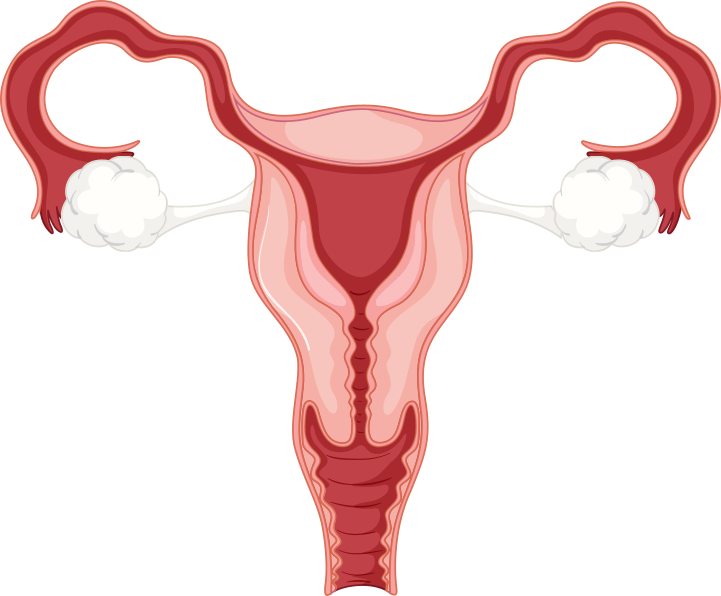
Tap any day of the cycle and watch what the uterus and ovaries are doing.
Interactive · By the Luna team · Updated
Tap on a day of the menstrual cycle and watch what happens in the picture.
The menstrual cycle is a set of changes in the female reproductive system. Each cycle, a lining builds up on the uterus. If there is no pregnancy, the lining is shed, and some of it leaves the body during the period.
Just like a day, week, or year, when one menstrual cycle ends another begins.
PeriodDay 1
Period
The lining of the uterus is shed, and some of it leaves the body through the vagina. This is the period. Day 1 of the cycle is the first day of the period.
28 days is only an average. Cycles can be shorter or longer, and yours may change from one to the next.
Period
The lining of the uterus is shed, and some of it leaves the body through the vagina. This is the period. Day 1 of the cycle is the first day of the period.
Lining builds
The period is over, and a new lining starts to build up on the inside of the uterus. An egg is waiting in the ovary.
Ovulation
The egg leaves the ovary and moves into the fallopian tube. The egg leaving the ovary is called ovulation. It happens about halfway through the cycle.
Egg dissolves
If there is no pregnancy, the egg dissolves about a day after it leaves the ovary. It does not leave the body with the period.
Lining builds
The lining keeps getting thicker. If there is no pregnancy, it will be shed, and the next period starts a new cycle at day 1.
It's hard to know exactly when your first period will come. It may happen around the same age that your mom or sisters first got theirs. When it does happen, you can talk to a trusted adult like a parent, teacher, or school nurse to get a hygiene product like a pad. You can also keep a pad in your backpack so you are prepared no matter when it comes. Friends are usually supportive and willing to share period products.
Is there a lot of blood?
Every person is different, and some people have heavier period flows than others. It may be helpful to know that the blood doesn't come out all at once, usually less than a teaspoon (3–5 milliliters) at a time. You may notice the blood seems a bit "chunky," which is normal.
How often will I get my period?
It can vary. Every 28 days is just the average (in fact, only around 15% of women actually have cycles that are exactly that long). "Normal" periods means normal for your body. Especially at the beginning, each cycle may be different and can be anywhere from 20–45 days apart. You may even skip periods. Later they will become more regular. You can keep track of your periods in your calendar to help know when the next one is coming.
How long is each period?
Again, everyone is different, but they can be anywhere from 2–7 days.
What is a tampon? A pad?
There are a lot of period products to stop the blood from getting on your clothes. Pads go in the underwear and catch the blood, and tampons go in the vagina and soak up the blood.
Does the egg leave the body with the period?
No. The egg dissolves about 24 hours after it leaves the ovary. The egg leaves the ovary halfway through the cycle, at the opposite time that the period happens. The egg leaving the ovary is called ovulation.